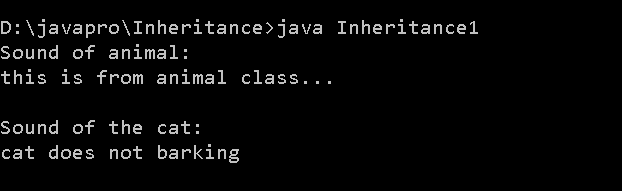
1. Write a Java program to create a class called Animal with a method called makeSound(). Create a subclass called Cat that overrides the makeSound() method to bark.
            /*Write a java program to create a class Animal with a method called makeSound(). Create a subclass called Cat that overrides the makeSound() method to bark */

            // Animal class
            class Animal {
                public void makeSound() {
                    System.out.println("this is from animal class...");
                }
            }

            // Cat subclass extending Animal
            class Cat extends Animal {
                @Override
                public void makeSound() {
                    System.out.println("cat does not barking"); // Cat overrides to bark
                }
            }

            class Inheritance1 {
                public static void main(String[] args) {
                    Animal genericAnimal = new Animal(); // Creating an instance of Animal
                    Animal myCat = new Cat(); // Creating an instance of Cat as Animal

                    System.out.println("Sound of animal:");
                    genericAnimal.makeSound(); // Calling makeSound() on the generic animal

                    System.out.println("\nSound of the cat:");
                    myCat.makeSound(); // Calling makeSound() on the cat (which will bark - overridden method)
                }
            }
Output
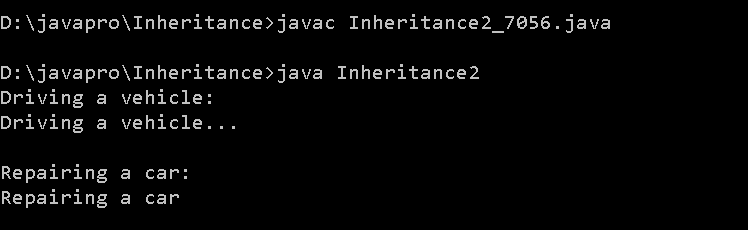
2. Write a Java program to create a class called Vehicle with a method called drive(). Create a subclass called Car that overrides the drive() method to print "Repairing a car".
            /* Write a Java program to create a class called Vehicle with a method called drive(). Create a subclass called Car that overrides the drive() method to print "Repairing a car". */

            // Vehicle class
            class Vehicle {
                public void drive() {
                    System.out.println("Driving a vehicle...");
                }
            }

            // Car subclass extending Vehicle
            class Car extends Vehicle {
                @Override
                public void drive() {
                    System.out.println("Repairing a car"); // Car overrides to repair
                }
            }

            class Inheritance2 {
                public static void main(String[] args) {
                    Vehicle vehicle = new Vehicle(); // Creating an instance of Vehicle
                    Vehicle car = new Car(); // Creating an instance of Car as Vehicle

                    System.out.println("Driving a vehicle:");
                    vehicle.drive(); // Calling drive() on the vehicle

                    System.out.println("\nRepairing a car:");
                    car.drive(); // Calling drive() on the car (which will repair - overridden method)
                }
            }
Output
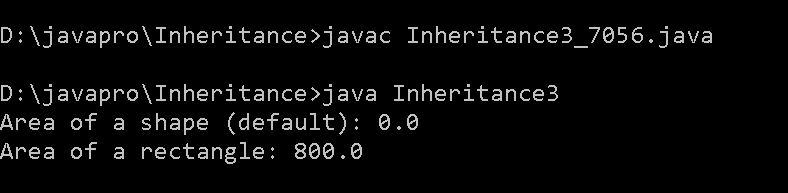
3. Write a Java program to create a class called Shape with a method called getArea(). Create a subclass called Rectangle that overrides the getArea() method to calculate the area of a rectangle.
            /*Write a Java program to create a class called Shape with a method called getArea(). Create a subclass called Rectangle that overrides the getArea() method to calculate the area of a rectangle. */

            // Shape class
            class Shape {
                public double getArea() {
                    return 0; // Default implementation for unknown shapes
                }
            }

            // Rectangle subclass extending Shape
            class Rectangle extends Shape {
                private double length;
                private double width;

                public Rectangle(double length, double width) {
                    this.length = length;
                    this.width = width;
                }

                @Override
                public double getArea() {
                    return length * width; // Calculate area of rectangle
                }
            }

            class Inheritance3 {
                public static void main(String[] args) {
                    Shape shape = new Shape(); // Creating an instance of Shape (will use default getArea())

                    Rectangle rectangle = new Rectangle(20, 40); // Creating an instance of Rectangle
                    double rectangleArea = rectangle.getArea(); // Calculating area of rectangle

                    System.out.println("Area of a shape (default): " + shape.getArea());
                    System.out.println("Area of a rectangle: " + rectangleArea);
                }
            }
Output
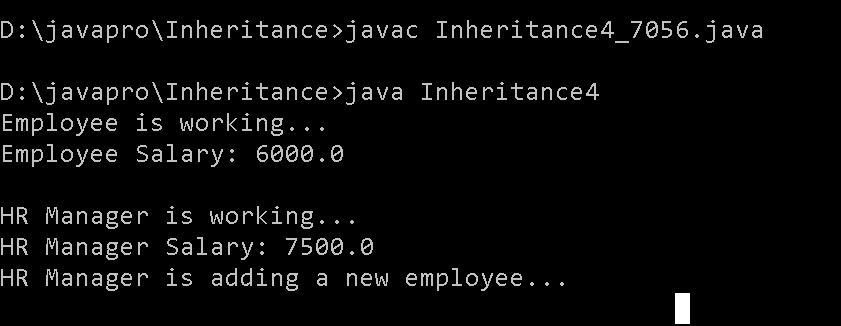
4. Write a Java program to create a class called Employee with methods called work() and getSalary(). Create a subclass called HRManager that overrides the work() method and adds a new method called addEmployee().
            /*Write a Java program to create a class called Employee with methods called work() and getSalary(). Create a subclass called HRManager that overrides the work() method and adds a new method called addEmployee(). */

            // Employee class
            class Employee {
                private double salary;

                public Employee(double salary) {
                    this.salary = salary;
                }

                public void work() {
                    System.out.println("Employee is working...");
                }

                public double getSalary() {
                    return salary;
                }
            }

            // HRManager subclass extending Employee
            class HRManager extends Employee {
                public HRManager(double salary) {
                    super(salary);
                }

                @Override
                public void work() {
                    System.out.println("HR Manager is working...");
                }

                public void addEmployee() {
                    System.out.println("HR Manager is adding a new employee...");
                }
            }

            class Inheritance4 {
                public static void main(String[] args) {
                    Employee emp = new Employee(6000); // Creating an instance of Employee
                    HRManager hrManager = new HRManager(7500); // Creating an instance of HRManager

                    emp.work(); // Calling work() for Employee
                    System.out.println("Employee Salary: " + emp.getSalary());

                    System.out.println();

                    hrManager.work(); // Calling work() for HRManager (overridden method)
                    System.out.println("HR Manager Salary: " + hrManager.getSalary());

                    hrManager.addEmployee(); // Calling addEmployee() for HRManager (specific method)
                }
            }
Output
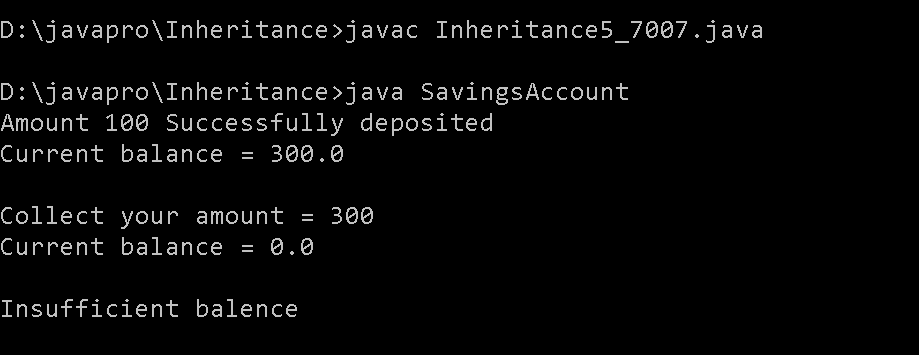
5. Write a Java program to create a class known as "BankAccount" with methods called deposit() and withdraw(). Create a subclass called SavingsAccount that overrides the withdraw() method to prevent withdrawals if the account balance falls below one hundred.
            /*Write a Java program to create a class known as "BankAccount" with methods called deposit() and withdraw(). Create a subclass called SavingsAccount that
            overrides the withdraw() method to prevent withdrawals if the account balance falls below one hundred.*/

            class BankAccount
            {
            float bal=0;

            BankAccount(){}
            BankAccount(float b)
            {
            bal=b;
            }

            void deposit(int b)
            {

            bal=bal+b;
            System.out.println("Amount " +b+ " Successfully deposited\nCurrent balance = " +bal+ "\n");
            }

            void withdraw(int b)
            {
            if (b>0 && b<=bal)
            {
            System.out.println("Collect your amount = " +b);
            bal=bal-b;
            System.out.println("Current balance = " +bal+ "\n");
            }
            else
            {
            System.out.println("Insufficient balance");
            }
            }
            }


            class SavingsAccount extends BankAccount
            {


            SavingsAccount(float b)
            {
            bal=b;
            }

            void withdraw(int b)
            {
            if(bal< 100 && bal< b)
            {
            System.out.println("Insufficient balence");
            }
            else
            {
            System.out.println("Collect your amount = " +b);
            bal=bal-b;
            System.out.println("Current balance = " +bal+ "\n");
            }
            }


            public static void main(String args[])
            {

            BankAccount obj1=new BankAccount(200);

            obj1.deposit(100);

            obj1.withdraw(300);


            SavingsAccount obj2=new SavingsAccount(10);
            obj2.withdraw(100);


            }


            }
Output
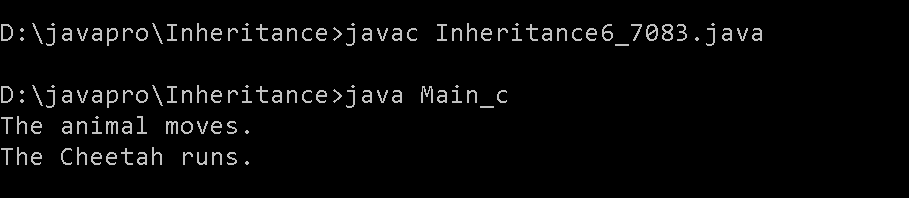
6. Write a Java program to create a class called Animal with a method named move(). Create a subclass called Cheetah that overrides the move() method to run.
class Animal {
  public void move() {
      System.out.println("The animal moves.");
  }
}

class Cheetah extends Animal {
 @Override
  public void move() {
      System.out.println("The Cheetah runs.");
  }
}

class  Main_c{
  public static void main(String x[] ) {
      Animal a = new Animal();
      Cheetah c = new Cheetah();
      a.move();
      c.move();
  }
}
Output
7. Write a Java program to create a class known as Person with methods called getFirstName() and getLastName(). Create a subclass called Employee that adds a new method named getEmployeeId() and overrides the getLastName() method to include the employee's job title
 //Write a Java program to create a class known as Person with methods called getFirstName() and getLastName(). Create a subclass called Employee that adds a new method named getEmployeeId() and overrides the getLastName() method to include the employee's job title

 class Person {
     private String firstName;
     private String lastName;

     public Person(String firstName, String lastName) {
         this.firstName = firstName;
         this.lastName = lastName;
     }

     public String getFirstName() {
         return firstName;
     }

     public String getLastName() {
         return lastName;
     }
 }

 class Employee extends Person {
     private int employeeId;
     private String jobTitle;

     public Employee(String firstName, String lastName, int employeeId, String jobTitle) {
         super(firstName, lastName);
         this.employeeId = employeeId;
         this.jobTitle = jobTitle;
     }

     public int getEmployeeId() {
         return employeeId;
     }


     public String getLastName() {
         return super.getLastName() + " (" + jobTitle + ")";
     }
 }

 class PersonAndEmployeeExample {
     public static void main(String[] args) {
         Person person = new Person("Bharat", "Bhatt");
         Employee employee = new Employee("Ravi", "Bhatt", 12345, "Software Engineer");

         System.out.println("Person: " + person.getFirstName() + " " + person.getLastName());
         System.out.println("Employee: " + employee.getFirstName() + " " + employee.getLastName() + ", Employee ID: " + employee.getEmployeeId());
     }
 }
Output

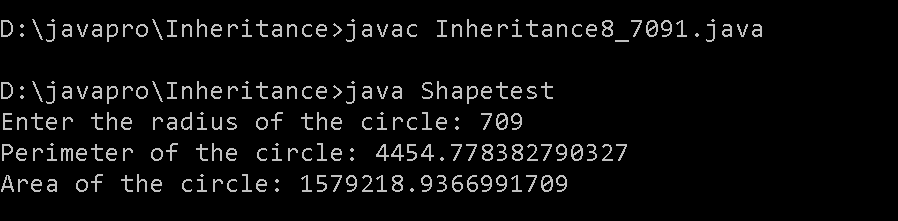
8. Write a Java program to create a class called Shape with methods called getPerimeter() and getArea(). Create a subclass called Circle that overrides the getPerimeter() and getArea() methods to calculate the area and perimeter of a circle.
            import java.util.Scanner;
            class Shape {
                public Shape() {
                }
                public double getPerimeter() {
                    System.out.println("Perimeter calculation for generic shape.");
                    return 0.0;
                }
                public double getArea() {
                    System.out.println("Area calculation for generic shape.");
                    return 0.0;
                }
            }
            class Circle extends Shape {
                private double radius;
                public Circle(double radius) {
                    this.radius = radius;
                }
                @Override
                public double getPerimeter() {
                    return 2 * Math.PI * radius;
                }
                @Override
                public double getArea() {
                    return Math.PI * radius * radius;
                }
            }
            class Shapetest {
                public static void main(String[] args) {
                    Scanner scanner = new Scanner(System.in);
                    System.out.print("Enter the radius of the circle: ");
                    double radius = scanner.nextDouble();
                    Circle circle = new Circle(radius);
                    System.out.println("Perimeter of the circle: " + circle.getPerimeter());
                    System.out.println("Area of the circle: " + circle.getArea());

                    scanner.close();
                }
            }
Output
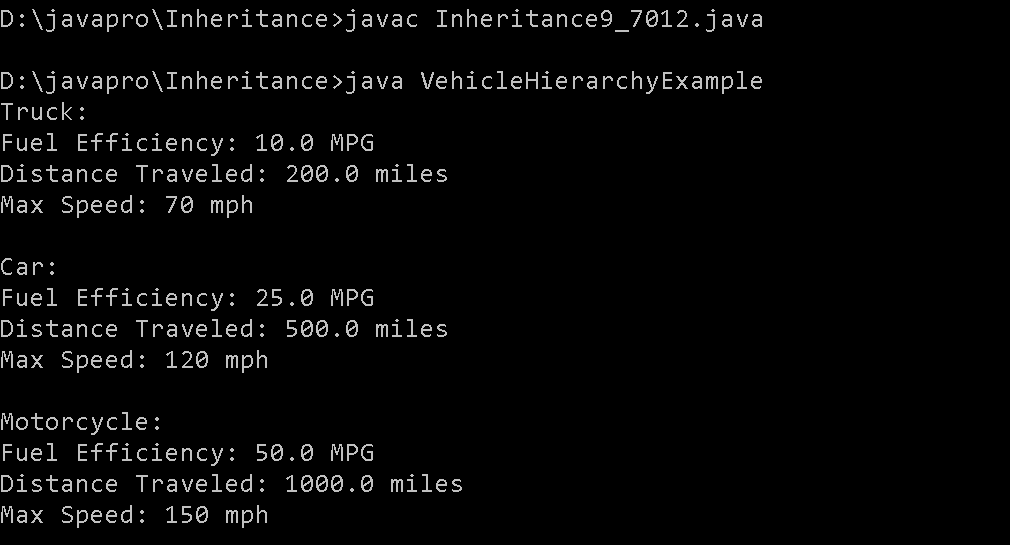
9. Write a Java program to create a vehicle class hierarchy. The base class should be Vehicle, with subclasses Truck, Car and Motorcycle. Each subclass should have properties such as make, model, year, and fuel type. Implement methods for calculating fuel efficiency, distance traveled, and maximum speed.
            class Vehicle {
              private String make;
              private String model;
              private int year;
              private String fuelType;

              public Vehicle(String make, String model, int year, String fuelType) {
                  this.make = make;
                  this.model = model;
                  this.year = year;
                  this.fuelType = fuelType;
              }

              public double calculateFuelEfficiency() {
                  return 0.0;  // Default implementation, to be overridden in subclasses
              }

              public double calculateDistanceTraveled(double fuelAmount) {
                  return 0.0;  // Default implementation, to be overridden in subclasses
              }

              public int getMaxSpeed() {
                  return 0;  // Default implementation, to be overridden in subclasses
              }
          }

          class Truck extends Vehicle {
              private int cargoCapacity;

              public Truck(String make, String model, int year, String fuelType, int cargoCapacity) {
                  super(make, model, year, fuelType);
                  this.cargoCapacity = cargoCapacity;
              }

              @Override
              public double calculateFuelEfficiency() {
                  // Implement the calculation for fuel efficiency specific to trucks
                  return 10.0;  // Example value in miles per gallon (MPG)
              }

              @Override
              public double calculateDistanceTraveled(double fuelAmount) {
                  // Implement the calculation for distance traveled specific to trucks
                  return fuelAmount * calculateFuelEfficiency();
              }

              @Override
              public int getMaxSpeed() {
                  return 70;  // Example maximum speed for a truck in mph
              }
          }

          class Car extends Vehicle {
              private int passengerCapacity;

              public Car(String make, String model, int year, String fuelType, int passengerCapacity) {
                  super(make, model, year, fuelType);
                  this.passengerCapacity = passengerCapacity;
              }

              @Override
              public double calculateFuelEfficiency() {
                  // Implement the calculation for fuel efficiency specific to cars
                  return 25.0;  // Example value in miles per gallon (MPG)
              }

              @Override
              public double calculateDistanceTraveled(double fuelAmount) {
                  // Implement the calculation for distance traveled specific to cars
                  return fuelAmount * calculateFuelEfficiency();
              }

              @Override
              public int getMaxSpeed() {
                  return 120;  // Example maximum speed for a car in mph
              }
          }

          class Motorcycle extends Vehicle {
              public Motorcycle(String make, String model, int year, String fuelType) {
                  super(make, model, year, fuelType);
              }

              @Override
              public double calculateFuelEfficiency() {
                  // Implement the calculation for fuel efficiency specific to motorcycles
                  return 50.0;  // Example value in miles per gallon (MPG)
              }

              @Override
              public double calculateDistanceTraveled(double fuelAmount) {
                  // Implement the calculation for distance traveled specific to motorcycles
                  return fuelAmount * calculateFuelEfficiency();
              }

              @Override
              public int getMaxSpeed() {
                  return 150;  // Example maximum speed for a motorcycle in mph
              }
          }

          class VehicleHierarchyExample {
              public static void main(String[] args) {
                  // Example usage of the vehicle classes
                  Truck myTruck = new Truck("Ford", "F-150", 2022, "Gasoline", 2000);
                  Car myCar = new Car("Toyota", "Camry", 2022, "Gasoline", 5);
                  Motorcycle myMotorcycle = new Motorcycle("Harley-Davidson", "Sportster", 2022, "Gasoline");

                  double fuelAmount = 20.0;  // Example fuel amount in gallons

                  System.out.println("Truck:");
                  System.out.println("Fuel Efficiency: " + myTruck.calculateFuelEfficiency() + " MPG");
                  System.out.println("Distance Traveled: " + myTruck.calculateDistanceTraveled(fuelAmount) + " miles");
                  System.out.println("Max Speed: " + myTruck.getMaxSpeed() + " mph");

                  System.out.println("\nCar:");
                  System.out.println("Fuel Efficiency: " + myCar.calculateFuelEfficiency() + " MPG");
                  System.out.println("Distance Traveled: " + myCar.calculateDistanceTraveled(fuelAmount) + " miles");
                  System.out.println("Max Speed: " + myCar.getMaxSpeed() + " mph");

                  System.out.println("\nMotorcycle:");
                  System.out.println("Fuel Efficiency: " + myMotorcycle.calculateFuelEfficiency() + " MPG");
                  System.out.println("Distance Traveled: " + myMotorcycle.calculateDistanceTraveled(fuelAmount) + " miles");
                  System.out.println("Max Speed: " + myMotorcycle.getMaxSpeed() + " mph");
              }
          }
Output
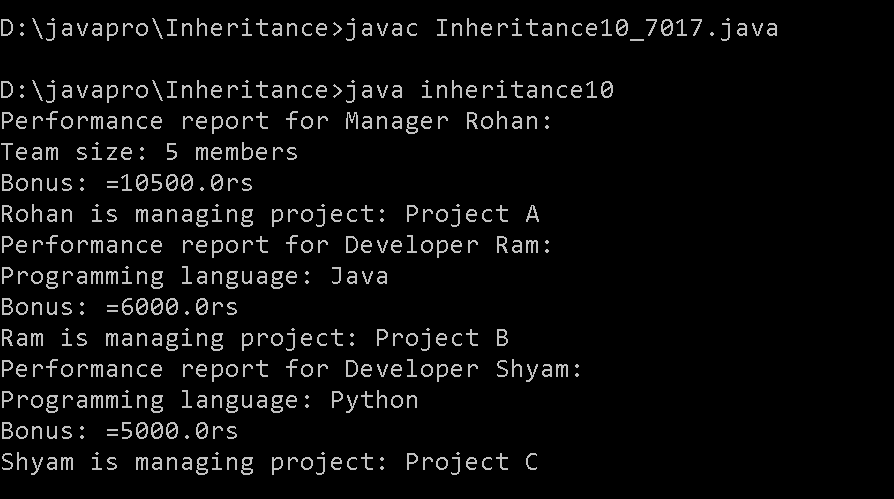
10. Write a Java program that creates a class hierarchy for employees of a company. The base class should be Employee, with subclasses Manager, Developer, and Programmer. Each subclass should have properties such as name, address, salary, and job title. Implement methods for calculating bonuses, generating performance reports, and managing projects.
            // Define the base class Employee
            class Employee {
                private String name;
                private String address;
                private double salary;
                private String jobTitle;

                public Employee(String name, String address, double salary, String jobTitle) {
                    this.name = name;
                    this.address = address;
                    this.salary = salary;
                    this.jobTitle = jobTitle;
                }

                public String getName() {
                    return name;
                }

                public String getAddress() {
                    return address;
                }

                public double getSalary() {
                    return salary;
                }

                public String getJobTitle() {
                    return jobTitle;
                }

                public double calculateBonus() {
                    return 0; // Default bonus calculation for generic Employee
                }

                public String generatePerformanceReport() {
                    return "Performance report for " + name + ":\n" +
                            "No specific performance metrics available.";
                }

                public void manageProject(String projectName) {
                    System.out.println(name + " is managing project: " + projectName);
                }
            }

            // Subclass Manager
            class Manager extends Employee {
                private int teamSize;

                public Manager(String name, String address, double salary, String jobTitle, int teamSize) {
                    super(name, address, salary, jobTitle);
                    this.teamSize = teamSize;
                }

                public int getTeamSize() {
                    return teamSize;
                }

                @Override
                public double calculateBonus() {
                    return getSalary() * 0.15; // Bonus calculation for Manager
                }

                @Override
                public String generatePerformanceReport() {
                    return "Performance report for Manager " + getName() + ":\n" +
                            "Team size: " + teamSize + " members";
                }
            }

            // Subclass Developer
            class Developer extends Employee {
                private String programmingLanguage;

                public Developer(String name, String address, double salary, String jobTitle, String programmingLanguage) {
                    super(name, address, salary, jobTitle);
                    this.programmingLanguage = programmingLanguage;
                }

                public String getProgrammingLanguage() {
                    return programmingLanguage;
                }

                @Override
                public double calculateBonus() {
                    return getSalary() * 0.1; // Bonus calculation for Developer
                }

                @Override
                public String generatePerformanceReport() {
                    return "Performance report for Developer " + getName() + ":\n" +
                            "Programming language: " + programmingLanguage;
                }
            }

            // Subclass Programmer
            class Programmer extends Developer {
                public Programmer(String name, String address, double salary, String programmingLanguage) {
                    super(name, address, salary, "Programmer", programmingLanguage);
                }

                // No need to override calculateBonus() and generatePerformanceReport()
            }

            // Main class to test the implementation
            class inheritance10 {
                public static void main(String[] args) {
                    Manager manager = new Manager("Rohan", "123 Main St", 70000, "Manager", 5);
                    Developer developer = new Developer("Ram", "456 Oak Ave", 60000, "Developer", "Java");
                    Programmer programmer = new Programmer("Shyam", "789 Elm Dr", 50000, "Python");

                    System.out.println(manager.generatePerformanceReport());
                    System.out.println("Bonus: =" + manager.calculateBonus()+"rs");
                    manager.manageProject("Project A");

                    System.out.println(developer.generatePerformanceReport());
                    System.out.println("Bonus: =" + developer.calculateBonus()+"rs");
                    developer.manageProject("Project B");

                    System.out.println(programmer.generatePerformanceReport());
                    System.out.println("Bonus: =" + programmer.calculateBonus()+"rs");
                    programmer.manageProject("Project C");
                }
            }
Output
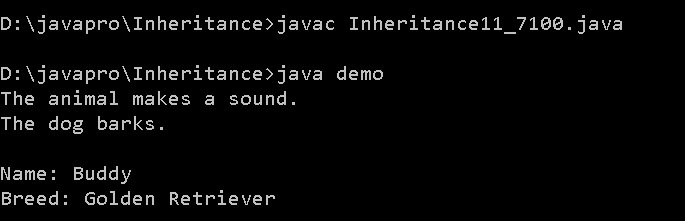
11. Create a program, showing an example of super keyword
class Animal {
  String name;

  Animal(String name) {
      this.name = name;
  }

  void makeSound() {
      System.out.println("The animal makes a sound.");
  }
}

class Dog extends Animal {
  String breed;

  Dog(String name, String breed) {
      super(name);

      this.breed = breed;
  }

  void makeSound() {
      super.makeSound();

      System.out.println("The dog barks.");
  }

  void displayInfo() {
      System.out.println("Name: " + name);
      System.out.println("Breed: " + breed);
  }
}

class demo {
  public static void main(String[] args) {
      Dog myDog = new Dog("Buddy", "Golden Retriever");
      myDog.makeSound();

      System.out.println();
      myDog.displayInfo();
  }
}
Output
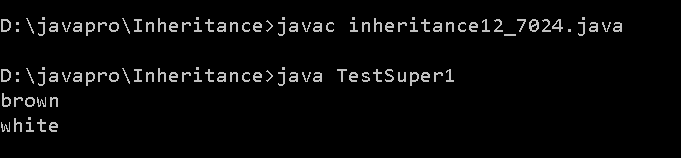
12. Create a program, showing an example of super function
            /* Create a program, showing an example of super function */

            class Animal{
            String color="white";
            }
            class Dog extends Animal{
            String color="brown";
            void printColor(){
            System.out.println(color);//prints color of Dog class
            System.out.println(super.color);//prints color of Animal class
            }
            }
            class TestSuper1{
            public static void main(String args[]){
            Dog d=new Dog();
            d.printColor();
            }}
Output
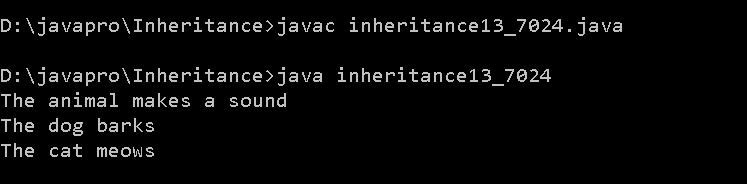
13. Create a program, showing an example of method overriding
            /*Create a program, showing an example of method overriding */

class Animal {
    void makeSound() {
        System.out.println("The animal makes a sound");
    }
}

class Dog extends Animal {
    @Override
    void makeSound() {
        System.out.println("The dog barks");
    }
}

class Cat extends Animal {
    @Override
    void makeSound() {
        System.out.println("The cat meows");
    }
}

public class inheritance13_7024 {
    public static void main(String[] args) {
        Animal animal = new Animal();
        animal.makeSound();

        Dog dog = new Dog();
        dog.makeSound();

        Cat cat = new Cat();
        cat.makeSound();
    }
}
Output
14. Create a program, showing an example of dynamic method dispatch
            class Std {
              public void print(){
                    System.out.println("Student details.");
              }
        }

        class ClgStd extends Std {
              public void print(){
                    System.out.println("College Student details.");
              }

              public static void main(String s[]){

               Std a = new ClgStd();
                a.print();
          }
        }
Output

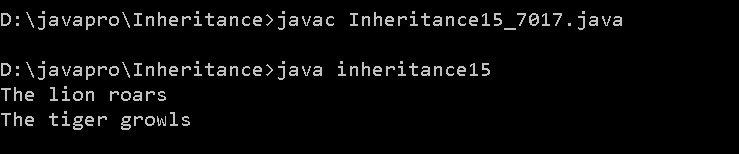
15. Write a Java program to create an abstract class Animal with an abstract method called sound(). Create subclasses Lion and Tiger that extend the Animal class and implement the sound() method to make a specific sound for each animale
            // Define the abstract class Animal
            abstract class Animal {
                abstract void sound(); // Abstract method for making a sound
            }

            // Subclass Lion
            class Lion extends Animal {
                @Override
                void sound() {
                    System.out.println("The lion roars");
                }
            }

            // Subclass Tiger
            class Tiger extends Animal {
                @Override
                void sound() {
                    System.out.println("The tiger growls");
                }
            }

            // Main class to test the implementation
             class inheritance15 {
                public static void main(String[] args) {
                    Animal lion = new Lion();
                    Animal tiger = new Tiger();

                    lion.sound(); // Output: The lion roars
                    tiger.sound(); // Output: The tiger growls
                }
            }
Output
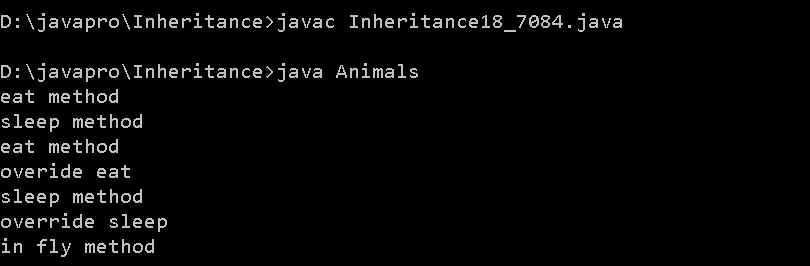
18. Write a Java program to create an abstract class Animal with abstract methods eat() and sleep(). Create subclasses Lion, Tiger, and Deer that extend the Animal class and implement the eat() and sleep() methods differently based on their specific behavior.
            class Animal {
              public void eat()
              {
                  System.out.println("eat method");

              }
              public void sleep()
              {
                  System.out.println("sleep method");

              }

          }
          class Bird extends Animal{

              public void eat() {
                  super.eat();
                  System.out.println("overide eat");
              }


              public void sleep() {
                  super.sleep();
                  System.out.println("override sleep");
              }

              public void fly()
              {
                  System.out.println("in fly method");

              }
          }
          class Animals{
              public static void main(String[] args) {
                  Animal a =new Animal();
                  Bird b = new Bird();
                  a.eat();
                  a.sleep();
                  b.eat();
                  b.sleep();
                  b.fly();
              }
          }
Output
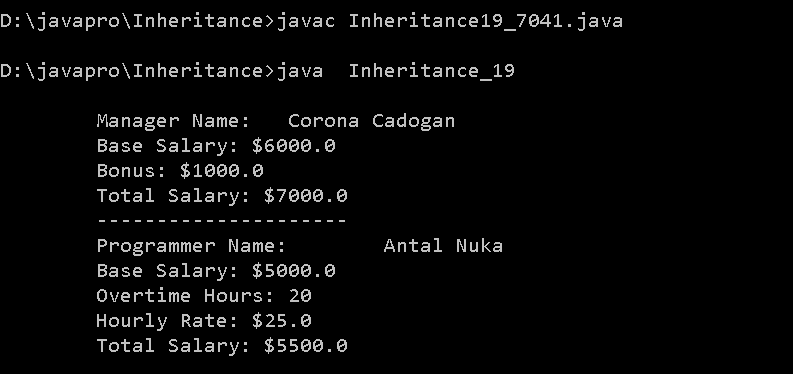
Inheritance program 19 - Write a Java program to create an abstract class Employee with abstract methods calculateSalary() and displayInfo(). Create subclasses Manager and Programmer that extend the Employee class and implement the respective methods to calculate salary and display information for each role
            //Employee.java
            abstract class Employee {
              protected String name;
              protected double baseSalary;

              public Employee(String name, double baseSalary) {
                this.name = name;
                this.baseSalary = baseSalary;
              }

              public abstract double calculateSalary();

              public abstract void displayInfo();
            }
            //Manager.java
            class Manager extends Employee {
              private double bonus;

              public Manager(String name, double baseSalary, double bonus) {
                super(name, baseSalary);
                this.bonus = bonus;
              }

              @Override
              public double calculateSalary() {
                return baseSalary + bonus;
              }

              @Override
              public void displayInfo() {
                System.out.println("\tManager Name: " + name);
                System.out.println("\tBase Salary: $" + baseSalary);
                System.out.println("\tBonus: $" + bonus);
                System.out.println("\tTotal Salary: $" + calculateSalary());
              }
            }
            //Programmer.java
            class Programmer extends Employee {
              private int overtimeHours;
              private double hourlyRate;

              public Programmer(String name, double baseSalary, int overtimeHours, double hourlyRate) {
                super(name, baseSalary);
                this.overtimeHours = overtimeHours;
                this.hourlyRate = hourlyRate;
              }

              @Override
              public double calculateSalary() {
                return baseSalary + (overtimeHours * hourlyRate);
              }

              @Override
              public void displayInfo() {
                System.out.println("\tProgrammer Name: " + name);
                System.out.println("\tBase Salary: $" + baseSalary);
                System.out.println("\tOvertime Hours: " + overtimeHours);
                System.out.println("\tHourly Rate: $" + hourlyRate);
                System.out.println("\tTotal Salary: $" + calculateSalary());
              }
            }
            //Main.java
            class Inheritance_19 {
              public static void main(String[] args) {
                System.out.println();
                Employee manager = new Manager("\tCorona Cadogan", 6000, 1000);
                Employee programmer = new Programmer("\tAntal Nuka", 5000, 20, 25.0);

                manager.displayInfo();
                System.out.println("\t---------------------");
                programmer.displayInfo();
              }
            }
Output
19. Write a Java program to create an abstract class Employee with abstract methods calculateSalary() and displayInfo(). Create subclasses Manager and Programmer that extend the Employee class and implement the respective methods to calculate salary and display information for each role.
            // Write a Java program to create an abstract class Shape3D with abstract methods calculateVolume() and calculateSurfaceArea(). Create subclasses Sphere and Cube that extend the Shape3D class and implement the respective methods to calculate the volume and surface area of each shape. (Program 20)
            // Created by Aryan , Rollno 7070
            // Note : In order to compile and run this program , rename it from "7070Inheritance20.java" to "Inheritance20.java"

            // Abstract class Shape3D
            abstract class Shape3D {
                // Abstract methods to calculate volume and surface area
                public abstract double calculateVolume();
                public abstract double calculateSurfaceArea();
            }

            // Subclass Sphere extending Shape3D
            class Sphere extends Shape3D {
                private double radius;

                // Constructor for Sphere
                public Sphere(double radius) {
                    this.radius = radius;
                }

                // Implementation of abstract method to calculate volume for Sphere
                @Override
                public double calculateVolume() {
                    return (4.0 / 3.0) * Math.PI * Math.pow(radius, 3);
                }

                // Implementation of abstract method to calculate surface area for Sphere
                @Override
                public double calculateSurfaceArea() {
                    return 4 * Math.PI * Math.pow(radius, 2);
                }
            }

            // Subclass Cube extending Shape3D
            class Cube extends Shape3D {
                private double side;

                // Constructor for Cube
                public Cube(double side) {
                    this.side = side;
                }

                // Implementation of abstract method to calculate volume for Cube
                @Override
                public double calculateVolume() {
                    return Math.pow(side, 3);
                }

                // Implementation of abstract method to calculate surface area for Cube
                @Override
                public double calculateSurfaceArea() {
                    return 6 * Math.pow(side, 2);
                }
            }

            // Main class for testing
            public class Inheritance20_7070 {
                public static void main(String[] args) {
                    // Create instances of Sphere and Cube
                    Sphere sphere = new Sphere(5.0);
                    Cube cube = new Cube(3.0);

                    // Display volume and surface area for Sphere
                    System.out.println("Sphere:");
                    System.out.println("Volume: " + sphere.calculateVolume());
                    System.out.println("Surface Area: " + sphere.calculateSurfaceArea());
                    System.out.println();

                    // Display volume and surface area for Cube
                    System.out.println("Cube:");
                    System.out.println("Volume: " + cube.calculateVolume());
                    System.out.println("Surface Area: " + cube.calculateSurfaceArea());
                }
            }
Output
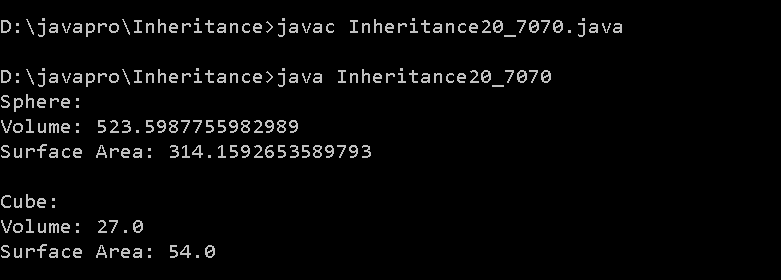
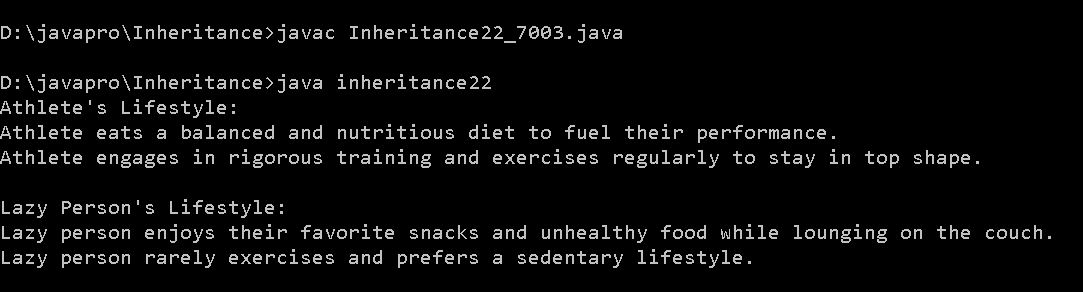
22. Write a Java program to create an abstract class Person with abstract methods eat() and exercise(). Create subclasses Athlete and LazyPerson that extend the Person class and implement the respective methods to describe how each person eats and exercises.
            abstract class Person {
              public abstract void eat();
              public abstract void exercise();
          }
          class Athlete extends Person {
              public void eat() {
                  System.out.println("Athlete eats a balanced and nutritious diet to fuel their performance.");
              }
              public void exercise() {
                  System.out.println("Athlete engages in rigorous training and exercises regularly to stay in top shape.");
              }
          }
          class LazyPerson extends Person {
              public void eat() {
                  System.out.println("Lazy person enjoys their favorite snacks and unhealthy food while lounging on the couch.");
              }

              public void exercise() {
                  System.out.println("Lazy person rarely exercises and prefers a sedentary lifestyle.");
              }
          }
          class inheritance22 {
              public static void main(String[] args) {
                  Athlete athlete = new Athlete();
                  LazyPerson lazyPerson = new LazyPerson();

                  System.out.println("Athlete's Lifestyle:");
                  athlete.eat();
                  athlete.exercise();

                  System.out.println("\nLazy Person's Lifestyle:");
                  lazyPerson.eat();
                  lazyPerson.exercise();

              }
          }
Output
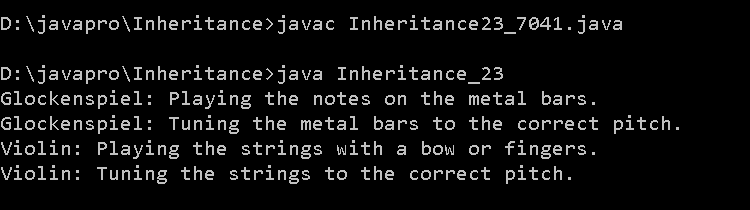
23. Write a Java program to create an abstract class Instrument with abstract methods play() and tune(). Create subclasses for Glockenspiel and Violin that extend the Instrument class and implement the respective methods to play and tune each instrument.
            //Instrument.java
            abstract class Instrument {
              public abstract void play();

              public abstract void tune();
            }
            //Glockenspiel.java
            class Glockenspiel extends Instrument {
              @Override
              public void play() {
                System.out.println("Glockenspiel: Playing the notes on the metal bars.");
              }

              @Override
              public void tune() {
                System.out.println("Glockenspiel: Tuning the metal bars to the correct pitch.");
              }
            }
            //Violin.java
            class Violin extends Instrument {
              @Override
              public void play() {
                System.out.println("Violin: Playing the strings with a bow or fingers.");
              }

              @Override
              public void tune() {
                System.out.println("Violin: Tuning the strings to the correct pitch.");
              }
            }
            //Main.java
            class Inheritance_23 {
              public static void main(String[] args) {
                Instrument glockenspiel = new Glockenspiel();
                Instrument violin = new Violin();

                glockenspiel.play();
                glockenspiel.tune();

                violin.play();
                violin.tune();
              }
            }
Output
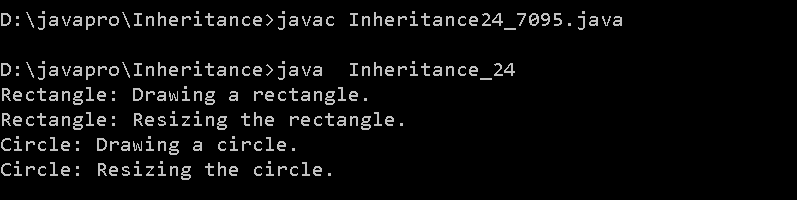
24. Write a Java program to create an abstract class Shape2D with abstract methods draw() and resize(). Create subclasses Rectangle and Circle that extend the Shape2D class and implement the respective methods to draw and resize each shape.
            //Shape2D.java
            abstract class Shape2D {
              public abstract void draw();

              public abstract void resize();
            }
            //Rectangle.java
            class Rectangle extends Shape2D {
              @Override
              public void draw() {
                System.out.println("Rectangle: Drawing a rectangle.");
              }

              @Override
              public void resize() {
                System.out.println("Rectangle: Resizing the rectangle.");
              }
            }
            //Circle.java
            class Circle extends Shape2D {
              @Override
              public void draw() {
                System.out.println("Circle: Drawing a circle.");
              }

              @Override
              public void resize() {
                System.out.println("Circle: Resizing the circle.");
              }
            }
            //Main.java
            class Inheritance_24 {
              public static void main(String[] args) {
                Shape2D rectangle = new Rectangle();
                Shape2D circle = new Circle();

                rectangle.draw();
                rectangle.resize();

                circle.draw();
                circle.resize();
              }
            }
Output
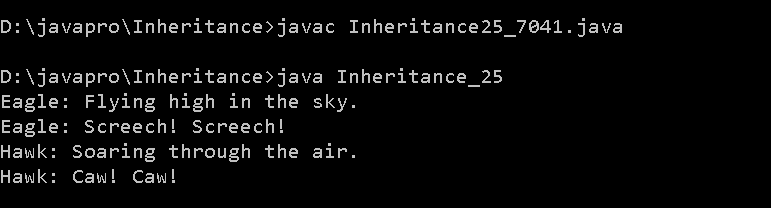
25. Write a Java program to create an abstract class Bird with abstract methods fly() and makeSound(). Create subclasses Eagle and Hawk that extend the Bird class and implement the respective methods to describe how each bird flies and makes a sound.
            //Bird.java
            abstract class Bird {
              public abstract void fly();

              public abstract void makeSound();
            }
            //Eagle.java
            class Eagle extends Bird {
              @Override
              public void fly() {
                System.out.println("Eagle: Flying high in the sky.");
              }

              @Override
              public void makeSound() {
                System.out.println("Eagle: Screech! Screech!");
              }
            }
            //Hawk.java
            class Hawk extends Bird {
              @Override
              public void fly() {
                System.out.println("Hawk: Soaring through the air.");
              }

              @Override
              public void makeSound() {
                System.out.println("Hawk: Caw! Caw!");
              }
            }
            //Main.java
            class Inheritance_25 {
              public static void main(String[] args) {
                Bird eagle = new Eagle();
                Bird hawk = new Hawk();

                eagle.fly();
                eagle.makeSound();

                hawk.fly();
                hawk.makeSound();
              }
            }
Output
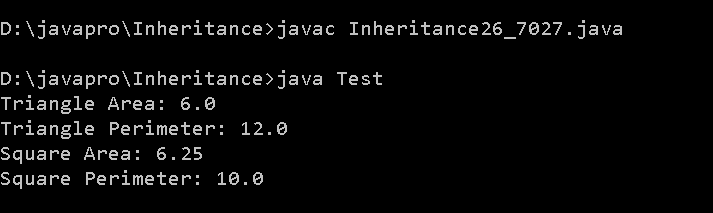
26. Write a Java program to create an abstract class GeometricShape with abstract methods area() and perimeter(). Create subclasses Triangle and Square that extend the GeometricShape class and implement the respective methods to calculate the area and perimeter of each shape
            /*
            26. Write a Java program to create an abstract class GeometricShape with abstract methods area() and perimeter(). Create subclasses Triangle and Square that extend the GeometricShape class and implement the respective methods to calculate the area and perimeter of each shape
        */
        abstract class GeometricShape
        {
            abstract double area();
            abstract double perimeter();
        }
        class Triangle extends GeometricShape
        {
            private double side1;
            private double side2;
            private double side3;

            public Triangle(double side1, double side2, double side3)
            {
                this.side1 = side1;
                this.side2 = side2;
                this.side3 = side3;
            }
            // Override
            double area()
            {
                double s = (side1 + side2 + side3) / 2;
                return Math.sqrt(s * (s - side1) * (s - side2) * (s - side3));
            }
            // Override
            double perimeter()
            {
                return side1 + side2 + side3;
            }
        }
        class Square extends GeometricShape
        {
            private double side;

            public Square(double side)
            {
                this.side = side;
            }
            // Override
            double area()
            {
                return side * side;
            }
            // Override
            double perimeter()
            {
                return 4 * side;
            }
        }
        class Test
        {
            public static void main(String[] args)
            {
                Triangle triangle = new Triangle(3.0, 4.0, 5.0);

                Square square = new Square(2.5);

                System.out.println("Triangle Area: " + triangle.area());
                System.out.println("Triangle Perimeter: " + triangle.perimeter());

                System.out.println("Square Area: " + square.area());
                System.out.println("Square Perimeter: " + square.perimeter());
            }
        }
Output